
How Restaurants Can Win Corporate Catering Clients
Ankit Narain
Customer Anchor
Read time : 9 min
Published November 19, 2026 · Updated November 19, 2026
Corporate catering is one of the few restaurant revenue channels where a single customer can be worth dozens of individual orders. One office manager who likes your food can book team lunches, client meetings, and training days all year. To put a hypothetical number on it, if that office orders for 25 people at $20 a head every other week, that is about $13,000 a year from one account. Most restaurants know this. Far fewer have a repeatable way to go and win those accounts.
The timing matters, too. In October 2026, one of the largest US delivery platforms agreed to pay $2.3 billion in cash for a leading corporate catering marketplace, a business whose average order is above $400. The biggest names in food delivery see corporate catering as a growth category worth paying for.
For restaurant operators, that raises a practical question. How do you get your share of this demand without depending only on marketplace listings, word of mouth, or the occasional website inquiry? This guide walks through the full process, from finding the right businesses to turning a first order into a recurring account.
Why most restaurant catering still depends on inbound inquiries
Ask a typical restaurant how they get catering orders and you will hear the same list: the website contact form, a social media post, a referral from a regular, a listing on a marketplace, or a phone call that comes out of nowhere.
These channels all share the same weakness. They are passive. They only work when a buyer already knows you exist, already needs catering, and chooses to reach out. That leaves real limits:
- Inconsistent volume. Inquiries arrive in bursts, so catering revenue swings from month to month.
- No control over who finds you. You get whoever happens to search, not the offices, clinics, and firms that would order every week.
- Competition at the point of decision. On a marketplace, your menu sits beside every other option, and price and convenience often decide the order.
- Slow or missed follow-up. When the team is busy running a dining room and a kitchen, an inquiry that sits for a day or two often goes to a competitor.
To win catering clients on a steady basis, add an active process to the inbound channels you already have. Inbound still matters, and a slow reply to an inquiry is one of the revenue leaks operators often miss. Inbound just shouldn’t be your whole strategy.
How to identify and reach businesses that are likely to order catering regularly
The first half of winning corporate catering clients happens before anyone contacts you. It is research, and it is where most restaurants skip ahead.
Define a realistic service area
Start with the delivery radius where you can consistently arrive on time with food at the right temperature. Corporate buyers are flexible on many things, but a late lunch for a 20-person meeting is rarely one of them. Be honest about your radius, and consider tiers: a close zone with no delivery fee, and a wider zone with a minimum order.
Pick target accounts that fit your kitchen
Not every business is a good catering customer. Look for companies that tend to feed groups on a recurring basis:
- Professional services firms such as law, accounting, consulting, and recruiting
- Medical, dental, and veterinary offices that feed staff and host lunch-and-learns
- Real estate, insurance, and financial offices that host client events
- Schools, universities, and training providers
- Construction, logistics, and property management companies with on-site crews
- Co-working spaces and larger offices with regular all-hands meetings
Then match them to your menu and capacity. A restaurant with strong sandwich platters and boxed lunches is a natural fit for weekday office meetings. A restaurant with hot trays and a larger production line may be better suited to events and larger gatherings.
Find the actual decision-maker
A generic info@ email rarely leads to an order. The person who books catering is usually an office manager, executive assistant, HR or people operations lead, or an events coordinator. At smaller firms, it can be the founder or general manager.
For each target account, collect:
- Company name, address, and approximate headcount
- The likely catering buyer's name, role, and direct contact details
- Any visible reason to reach out now, such as a new office, a hiring push, or an upcoming event
- Notes on dietary or cultural considerations that could shape your menu suggestions
This information is what turns a cold message into a relevant one. It is also the most time-consuming part of the process, which is why many restaurants never get started.
How to build a follow-up and quoting process without adding a full-time salesperson
Most restaurants don't need a salesperson. They need a process that doesn't depend on someone remembering to send an email between the lunch rush and dinner prep.
Start outreach with something useful
A good first message is short, specific, and easy to say yes to. It names the business, shows you understand how they might use catering, and offers a low-commitment next step, such as a sample tasting, a one-page menu with group pricing, or a trial order for an upcoming meeting. Avoid long introductions about your restaurant's history. The reader wants to know what's in it for the team.
Keep it clean. Honor every opt-out right away, keep a do-not-contact list, and use business contact details from reputable sources. Rules for texts and calls vary by state, so check them before running outreach at volume.
Follow up on a schedule
Most corporate catering deals are not won on the first message. Buyers are busy, and timing is everything. A simple cadence works well:
The goal is to be consistently present, not pushy. Tracking who has been contacted, who replied, and when to follow up next is what keeps this from falling apart.
Send quotes that are easy to approve
Speed and clarity win corporate catering orders. A strong quote includes:
- Menu and pricing: an itemized menu with per-person pricing and the total.
- Headcount: your assumptions, and how late changes are handled.
- Delivery or setup: date, time window and fee.
- Dietary options: vegetarian, vegan, gluten-free and allergen notes.
- Payment and approval: terms, and an easy way to approve, whether a reply, a link or an invoice.
Many corporate buyers need to expense or route an order for approval, so make the paperwork painless. Quoting within hours rather than days is often what separates a won order from a lost one.
Track every opportunity
Even a simple tracker will do. For each lead, record the stage (researched, contacted, replied, quoted, confirmed, delivered), the next action, and the date it's due. Without this, opportunities slip through quietly, and you never learn which accounts or messages actually produce orders.
How to turn the first corporate catering order into a recurring account
The first order is a trial. What happens after delivery decides whether it becomes a one-off or a standing account.
- Follow up within a day or two. Ask how the food arrived and whether the team enjoyed it. This feedback is useful, and it shows you care about the account.
- Record preferences. Note headcount, favorite items, dietary needs, delivery instructions, and who approves the order. Next time, you can offer a pre-filled suggestion in a minute.
- Suggest the next order before they think of it. If a team ordered for a Monday meeting, propose the same for next month, or suggest a weekly or biweekly rhythm.
- Time reorders around their calendar. Quarterly reviews, onboarding days, busy seasons, and holidays all create natural reasons to reach out.
- Make reordering effortless. The easier it is to repeat last time's order, the less likely the account is to drift to someone else.
- Ask for introductions. A satisfied office manager often knows peers at neighboring businesses, and a warm referral beats any cold email.
Over time, the data you collect on each account becomes one of your most valuable assets. It lets you predict demand, plan staffing and prep, and prioritize the customers who matter most.
Corporate catering requires an active sales process
Winning corporate catering clients comes down to one process, worked every week, not whenever someone has time.
- 1. Define your area A radius you can serve
- 2. Pick accounts Groups that order often
- 3. Find the buyer Who places the order
- 4. Reach out Day 0, 3 to 4, 8 to 10
- 5. Quote and close Itemized, easy to approve
- 6. Win repeat orders Follow up and reorder
The six steps: define your area, pick accounts, find the buyer, reach out, quote and close, and win repeat orders.
The first five steps win the order. The sixth turns it into a standing account.
Kutlerri.ai builds AI agents that grow restaurant revenue and cut cost. The first, the AI catering sales agent, runs this process for you as a managed service. The AI agent delivers the speed. The human agents deliver the judgment.
Built over ten months inside RASA, a five-location fast-casual group in the DMV, the agent booked $450,000 in new catering revenue without a single new hire.
We bring the catering orders. You manage the kitchen. See how it would work on your menu, radius and prices. Book a demo.
Frequently asked questions
How do restaurants get corporate catering clients?
Define a delivery radius you can serve reliably, list nearby businesses that feed groups often, find the person who books catering and reach out with a specific offer. Follow up on a schedule, quote within hours and turn the first order into a standing account.
Who books catering at a company?
Usually an office manager, executive assistant, HR or people operations lead, or events coordinator. At smaller firms, the founder or general manager often books it.
How often should a restaurant follow up on a catering lead?
Three to four touches over about ten days works for most leads: an initial offer, one or two follow-ups that each add something new, and a final easy-to-answer check-in. After that, a light touch every few weeks for anyone who said "later".
What does Kutlerri cost?
For managed services, pricing at Kutlerri.ai is outcome-based. We charge a percentage of the catering orders our outbound work brings in, plus a percentage for running your entire inbound workflow. Rates are set for each restaurant based on the number of locations, catering volume, cuisine and market.
Who actually makes the calls and talks to my customers?
The Kutlerri AI agent answers inbound calls, emails, texts and web forms and handles the first reply. A dedicated Kutlerri outbound team, one or two people assigned to your stores, plans and runs the outreach calls, emails and texts, and steps into any inbound conversation that needs a person. No quote reaches a customer until you approve it.
What do I have to do?
Share your catering menu and discount rules, POS access and order history, marketplace data and brand assets. Then approve quotes from your phone. Kutlerri starts in weeks, not quarters. Planning the outreach and warming up the pipeline takes time, so the first quarter is the ramp-up: that is when outreach builds momentum and results start to show.
Will Kutlerri replace my catering person?
No. Kutlerri's AI agent and outbound team do the outreach and follow-up your team never gets to. Your team keeps the relationships and the last word on every quote.
Do Kutlerri's agents answer inbound inquiries too?
Yes. Kutlerri's AI agent answers catering calls, emails, texts and web forms around the clock, and handles the back and forth on date, headcount, budget and dietary needs. When a conversation needs a person, our team steps in. Then it sends the quote once you approve it and closes the order.

Kutlerri.ai maps your catering demand, builds the prospect database, runs the outbound motion, and handles every inbound inquiry so your catering program runs like a revenue engine, not an afterthought.
Get a demo
How Restaurants Can Win Corporate Catering Clients
A practical guide for restaurants on winning corporate catering clients: research accounts, reach buyers, follow up, send quotes and earn repeat orders.
Read more →
7 Restaurant Revenue Leaks That Operators Often Miss
A busy restaurant can still lose money between the order and the bank. Seven common revenue leaks, from unanswered catering inquiries to marketplace fees, how to spot each one, and how to start fixing it.
Read more →
Why Every Marketplace Order Is Building Someone Else's Loyalty Program
Every DoorDash, Uber Eats and ezCater order builds a customer profile the platform keeps. Here is who owns the customer, and what a direct catering account returns to the restaurant instead.
Read more →
The Catering Playbook: How to Build a Revenue Channel That Runs Without Chaos
Most restaurants capture 4 to 8% of their catering potential. The benchmark for operators running it as a real channel is 20%. What is sitting uncaptured within ten miles of your location right now?
Read more →
Your Restaurant Is Sitting on a Catering Goldmine. Here's What's Blocking It.
Most restaurants don't have a catering operation. They have a catering habit. What would change if every inquiry, every quote, and every follow-up ran through the same system every single time?
Read more →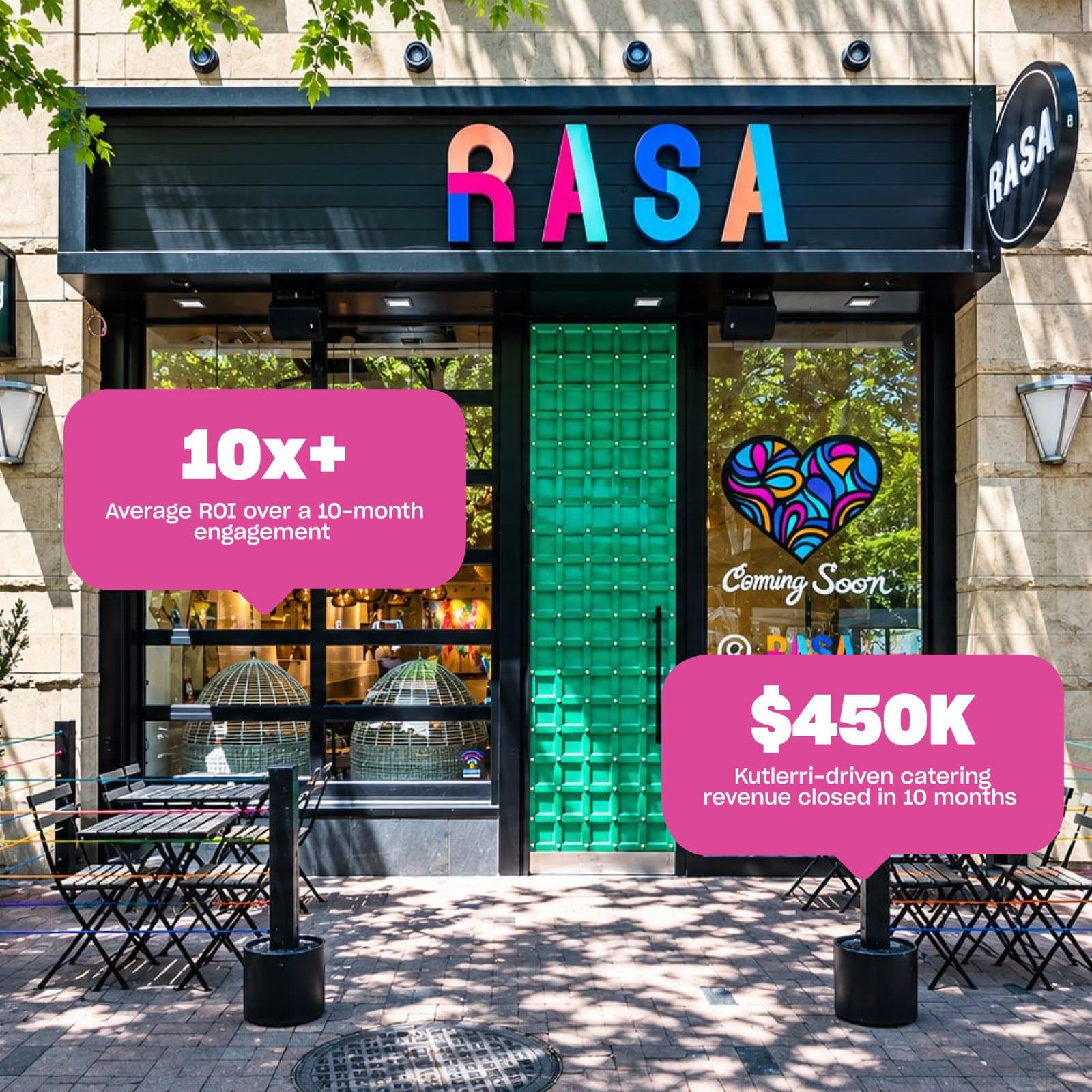
How RASA Closed $450K in New Catering Revenue in 10 Months Without Hiring Anyone
Ten months ago, RASA waited for catering orders to come in. Today, an AI agent goes out and gets them. See how Kutlerri.ai's Catering Sales Agent closed $450K in new catering revenue, more than 10 times what RASA paid.
Read more →