
7 Restaurant Revenue Leaks That Operators Often Miss
Rishabh Srivastav
Founding Team
Read time : 9 min
Published November 10, 2026 · Updated November 10, 2026
It is a strange feeling to run a busy restaurant and still wonder where the money went.
The dining room was full on Saturday. Delivery tickets kept printing. The catering inbox had messages in it. Yet when the month closes, the profit line looks thinner than the effort behind it.
Most of the time, demand is not what is missing. Margin is leaking out somewhere between the order and the bank. A restaurant revenue leak is revenue or margin a restaurant could reasonably have captured but lost to a process gap, a missed follow-up, weak retention, an unnecessary fee, or avoidable operating work.
This is why sales volume does not always equal profitable growth. You can add orders and still lose ground if they arrive through a costly channel, if guests never return, or if the kitchen throws away what the extra volume was meant to pay for. Below are seven common restaurant revenue leaks, how each one happens, how to recognize it, and how to start fixing it. The dollar figures are hypothetical, there to show the math.
The seven leaks fall into two groups. Four are revenue you never collected: catering demand, cold leads, lapsed guests and missed add-ons. Three are costs that quietly eat the margin on sales you already made: marketplace fees, marketing you cannot measure, and manual work and waste. Growing a restaurant profitably means working both sides, not just chasing more orders.
Leak 1: Catering revenue you never capture
A catering order can be worth many times an average check. It is also easy to lose, because inquiries arrive in awkward places.
How the leak happens
- The inquiry lands in a website form, voicemail, direct message or general inbox that nobody checks daily.
- The person who handles catering is also running the line.
- Pricing lives in someone's head, so quotes take days.
- Nobody reaches out to the offices, schools, clinics and venues nearby that order catering every week, so the restaurant only gets the orders that happen to find it.
How to recognize it
Count the catering inquiries from the last 90 days. How many got a reply within hours, and how many became orders? If you cannot answer quickly, that is the finding. If you get ten catering inquiries a month and lose three that would have booked at $500 each, that is $1,500 a month, or about $18,000 a year.
How to start fixing it
Send every inquiry to one inbox, set a same-day reply goal, and build a pricing template so a quote takes minutes, not days. Then go after the demand that never reaches your inbox: list the businesses within a few miles that order catering, and introduce yourself with a menu and a first-order offer.
Leak 2: Weak lead follow-up
A lead is anyone who showed interest but has not ordered yet: a private-dining request, a large-party booking or a corporate account asking about pricing. A first reply is not follow-up. People compare options, and the restaurant that checks back politely often wins.
How the leak happens
- A quote or answer goes out, and then silence.
- Follow-up depends on someone remembering.
- There is no record of where each lead stands.
How to recognize it
Review last quarter's quotes and requests. How many received a second message, and how many converted? If most got exactly one reply, you have found a leak.
How to start fixing it
Keep one list of open leads, each with a next-step date. A shared tracker or a restaurant CRM that logs every inquiry makes this easy. Agree on a simple rhythm, such as a check-in two days after the first reply and another near the decision date. Two polite check-ins are usually enough to keep a good lead alive. The catch is that the person who should send them is usually also running a shift, which makes follow-up a staffing problem, not a discipline problem, and exactly the kind of repetitive work software now handles well.
Leak 3: Lapsed customers and lost repeat revenue
Regulars rarely announce they are leaving. They just stop showing up, and a busy week hides it. They already know your food, so a well-timed message is often all it takes. A new guest, by contrast, usually costs you ad spend or a marketplace commission.
How the leak happens
- Nobody tracks how long it has been since each customer last ordered.
- Orders come through channels that do not share customer details with you.
- Outreach, when it happens, is generic and badly timed.
How to recognize it
Sort your order history by last order date. How many customers ordered more than once but have been quiet for 60 to 90 days? Also watch your repeat-order rate: the share of this quarter's customers who had ordered before. Win back 10% of 400 lapsed customers, and if each of those 40 guests orders four more times a year at $35, that is about $5,600 a year.
How to start fixing it
Define "lapsed" for your concept, since a weekly lunch spot and a monthly family-dinner place differ. Then send something tied to what each guest used to order, not a blanket blast. A customer database or ordering system that records last-order dates makes this list quick to pull.
Leak 4: Marketplace commissions and limited customer ownership
Marketplaces can bring visibility and orders, and many restaurants rightly use them. The leak appears when you do not know the real cost, or when every order comes from a customer you cannot contact again.
How the leak happens
- Delivery marketplaces publish commissions of roughly 15% to 30% on delivery orders, depending on the plan, before promotions and other fees. Check your own agreement.
- The marketplace usually holds the customer relationship.
How to recognize it
Add up one month of commissions, fees, funded promotions and adjustments, then divide by that marketplace's gross sales. That is your effective cost rate. Compare it with food and labor cost on the same orders. Many operators are surprised by what is left.
How to start fixing it
You need not leave. Treat marketplaces as a way to meet new guests, then offer a reason to order direct, like a loyalty perk or an exclusive item. Review pricing by channel so fees do not come out of margin by default. The largest marketplaces also offer commission-free ordering on your own website, where you pay a processing fee instead, so moving repeat guests there keeps both the customer relationship and the margin. A card tucked into delivery bags can invite guests to order direct next time.
Leak 5: Missed upsell and cross-sell opportunities
The cheapest revenue rides on an order that is already happening.
How the leak happens
- Staff are not prompted or trained to suggest add-ons.
- Online checkout offers nothing extra.
- Menus and bundles ignore natural pairings.
- Catering quotes match the request exactly, with no suggestion for drinks or desserts.
How to recognize it
Compare average order value across dine-in, pickup, delivery and catering. Then check attach rates: what share of entrées come with a drink, side or dessert?
How to start fixing it
Pick one or two natural pairings and make them effortless, like a suggested side at checkout or a drink pairing on the menu. Measure the attach rate before and after. Give staff one simple line to offer, like the house drink or a shareable side.
Leak 6: Marketing spend that does not produce measurable orders
The leak is marketing spend you cannot tie to a single order.
How the leak happens
- Posts, ads and promotions have no unique link, code or offer to trace.
- Discounts go to guests who would have paid full price.
- Results are judged by likes and impressions instead of orders and repeat visits.
How to recognize it
List the last 90 days of marketing spend and write, beside each item, the orders you can attribute to it. Every blank means you are guessing.
How to start fixing it
Give each campaign its own link, code or offer. Judge it on orders, new versus returning customers, and whether they came back. Be deliberate about who gets a discount. A quick "How did you hear about us?" at checkout helps fill in the gaps.
Leak 7: Manual work, food waste and labor costs that erode growth
This leak is margin you did not keep. Three numbers show it:
- Food cost percentage: cost of goods sold divided by food sales.
- Labor cost percentage: labor cost divided by total sales.
- Prime cost: cost of goods sold plus labor. According to restaurant consultants Foster and Associates, writing for Baker Tilly in 2024, targets run roughly 58% to 62% of sales depending on the type of restaurant, and prime cost above 65% makes profit very hard to reach unless sales volume is unusually high.
How the leak happens
- Staff retype orders or reconcile channels by hand.
- Prep levels follow habit instead of what is selling.
- Waste goes unmeasured.
- Schedules ignore demand patterns.
How to recognize it
Track your restaurant food cost percentage, labor cost percentage and prime cost weekly instead of monthly, keep a two-week waste log, and ask your team which repeated task feels like it should not need a person.
How to start fixing it
Tackle the biggest source of waste or manual work first. Match prep and scheduling to what actually sells, and tighten portioning where it is loose. Where orders are retyped by hand, look for ordering and catering tools that pass details straight to the kitchen.
How to identify and prioritize your most costly leaks
You do not need a data team. Review order history, customer activity, catering inquiries, marketing performance, marketplace fees, labor, food waste and repeat-order rates with one question in mind: where are we losing revenue or margin that we could reasonably recover? Put a rough dollar figure beside each leak, then rank them by:
- Financial impact: how much it likely costs you over a year.
- Frequency: how often it happens. A small daily leak can outweigh a big, rare one.
- Ease of correction: how simple the fix is.
- Repeat revenue potential: whether fixing it keeps paying you back.
For many restaurants that points to lapsed customers and lead follow-up before a deep operations overhaul. Fix one or two, measure the result, then move on.
Example annual cost per leak
Hypothetical figures from the worked examples above, per year
Conclusion
Most leaks show up in four places: the inbox, the customer list, the fee statement and the prep sheet. Fix the revenue you have already earned before you pay to chase more demand.
Start with one leak this week. Count it, put a dollar figure on it, and fix it.
FAQ
What is a restaurant revenue leak?
A revenue leak is revenue or margin a restaurant could reasonably have captured but lost to a process gap, a missed follow-up, weak retention, an unnecessary fee or avoidable operating work.
How can a restaurant increase revenue without more customers?
Start with the customers and leads you already have. Reply faster to inquiries, follow up on quotes, win back lapsed guests, and add natural upsells to orders that are already happening.
How do I calculate food cost and labor cost percentage?
Food cost percentage is the cost of goods sold divided by food sales. Labor cost percentage is total labor cost divided by total sales. Track both weekly to catch changes sooner.
What is a restaurant's prime cost?
Prime cost is the cost of goods sold plus labor cost. Targets run roughly 58% to 62% of sales depending on the type of restaurant, and prime cost above 65% makes profit very hard to reach unless sales volume is unusually high.
How can a restaurant increase profits?
Start by finding your restaurant profit leaks: unanswered leads, lapsed customers, costly channels, unmeasured marketing and avoidable food and labor costs. Fix the largest, most frequent ones first and track prime cost weekly to confirm the result.
How can AI for restaurants help find revenue leaks?
AI agents can take on the repetitive work behind most leaks: replying to every catering inquiry within minutes, following up on open quotes, spotting guests who have gone quiet and flagging channels that cost more than they earn. Kutlerri.ai's AI catering sales agent does this for catering today, and owners still approve the decisions that matter.

Kutlerri.ai maps your catering demand, builds the prospect database, runs the outbound motion, and handles every inbound inquiry so your catering program runs like a revenue engine, not an afterthought.
Get a demo
7 Restaurant Revenue Leaks That Operators Often Miss
A busy restaurant can still lose money between the order and the bank. Seven common revenue leaks, from unanswered catering inquiries to marketplace fees, how to spot each one, and how to start fixing it.
Read more →
Why Every Marketplace Order Is Building Someone Else's Loyalty Program
Every DoorDash, Uber Eats and ezCater order builds a customer profile the platform keeps. Here is who owns the customer, and what a direct catering account returns to the restaurant instead.
Read more →
The Catering Playbook: How to Build a Revenue Channel That Runs Without Chaos
Most restaurants capture 4 to 8% of their catering potential. The benchmark for operators running it as a real channel is 20%. What is sitting uncaptured within ten miles of your location right now?
Read more →
Your Restaurant Is Sitting on a Catering Goldmine. Here's What's Blocking It.
Most restaurants don't have a catering operation. They have a catering habit. What would change if every inquiry, every quote, and every follow-up ran through the same system every single time?
Read more →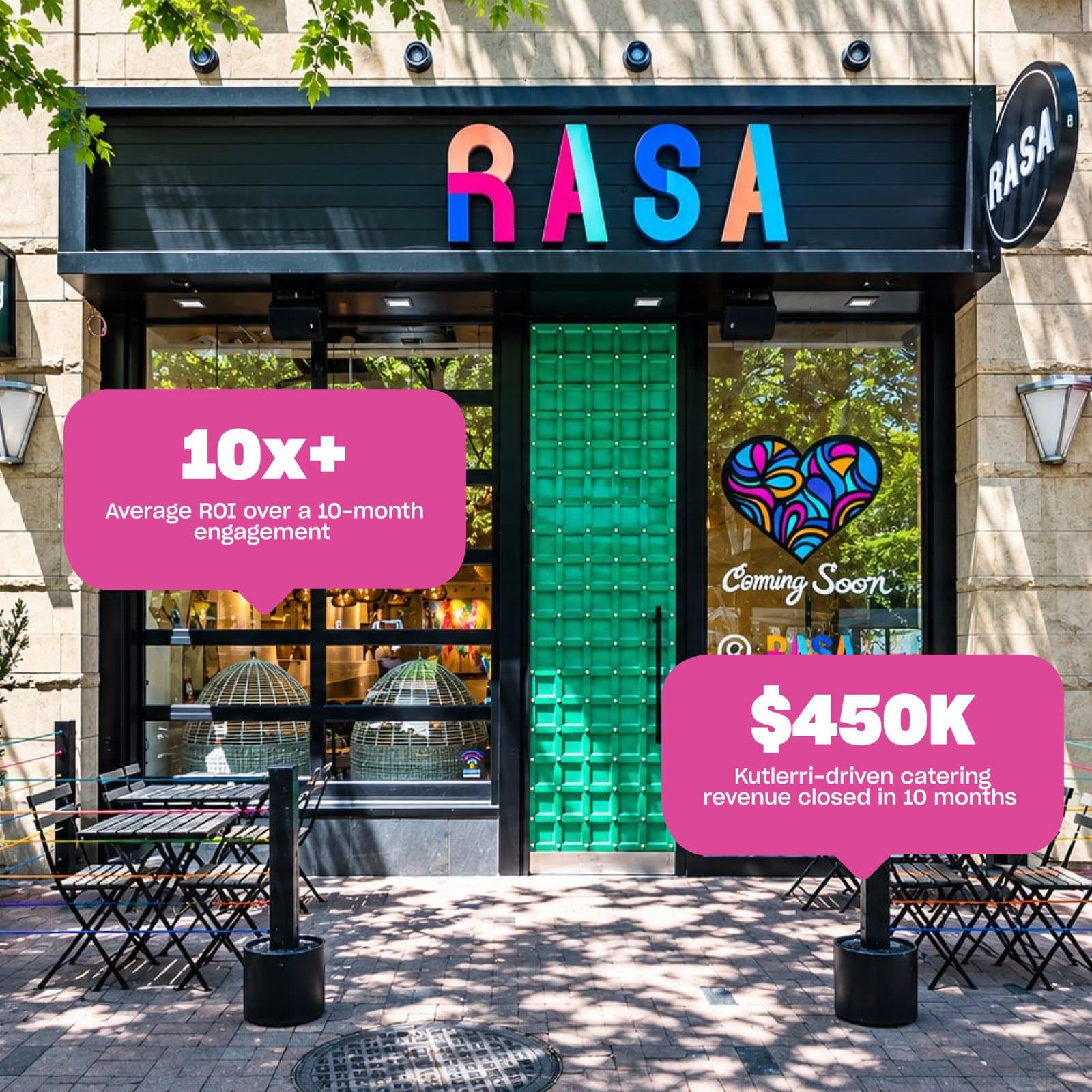
How RASA Closed $450K in New Catering Revenue in 10 Months Without Hiring Anyone
Ten months ago, RASA waited for catering orders to come in. Today, an AI agent goes out and gets them. See how Kutlerri.ai's Catering Sales Agent closed $450K in new catering revenue, more than 10 times what RASA paid.
Read more →